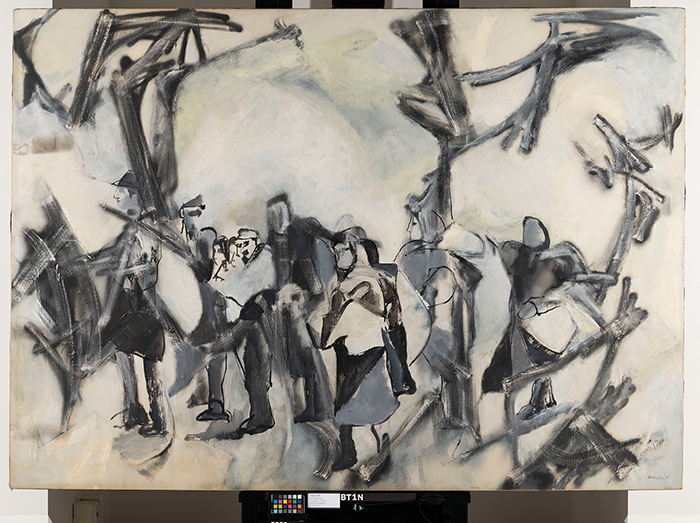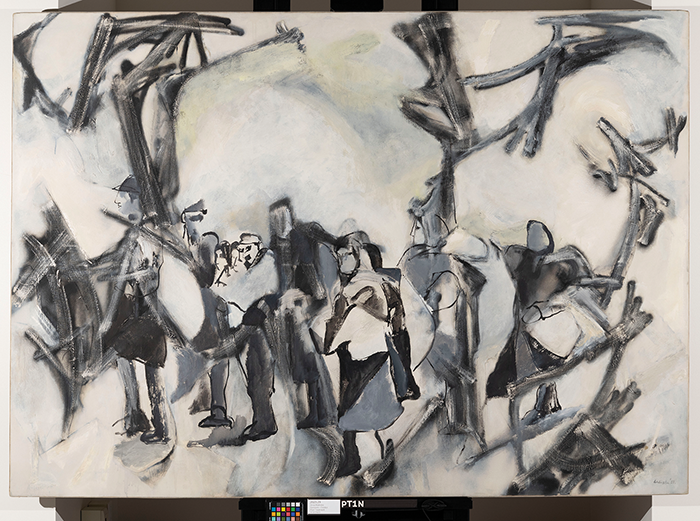

Balance is key to a museum’s relationship with art—as institutions benefit from an artist’s vision, they preserve art for future generations. Anna Walinska’s Survivors—Exodus in the Eskenazi Museum’s permanent collection tells the story of human resilience in the face of unbearable suffering.
Walinska’s life and art span a century of American modernism, paralleling the history of the New York school and the American Jewish experience. Over her lifetime, she created more than two thousand works on canvas and paper, many of which are in collections that include the United States Holocaust Memorial Museum, the High Museum, the Herbert F. Johnson Museum of Art at Cornell University, and Yad Vashem. Survivors—Exodus, a 2023 gift from Rosina Ruben to the Eskenazi Museum of Art, appears in the fall 2025 exhibition Remembrance and Renewal: American Artists and the Holocaust, 1940–1970.
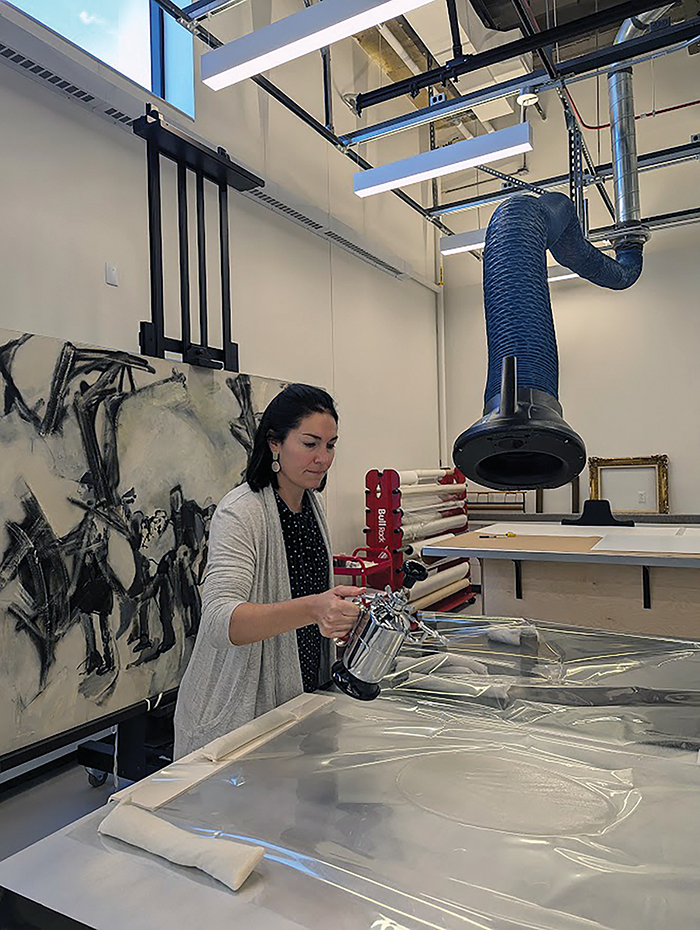
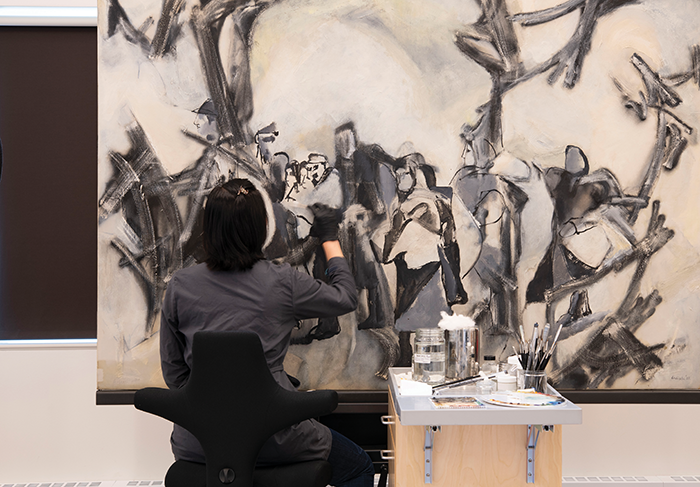
Conservation intervention is often necessary before a work of art is installed in the gallery. This was the case with Walinska’s painting, and the Eskenazi Museum’s former Beverly and Gayl W. Doster Paintings Conservator, Julie Ribits, worked to restore it before the opening of the exhibition. Of the project, Julie shared, “This painting had come to us after years in storage and had shown signs of accumulated surface dust and grime, as well as three distinct scorch marks along the left edge of the work, which indicated it may have been stored on its side near lamps. It had a broken cross bar on its stretcher and multiple small tears around the perimeter.”
Walinska used modern painting materials, including oil and spray paint, in the creation of the work. The areas of spray paint in the composition proved to be water sensitive during the testing phase of treatment, which made it tricky to clean using aqueous methods.